
Fee, Staffing, and Schedule
A requirement found after the firm sets its approach can create redesign or unplanned effort.

VeraFix™ | A Polaris Strategy & Capture Consulting Service
Federal AE work is typically governed by more than what is stated in the scope of work. Criteria, site conditions, Government processes, and approvals can surface only after the firm has begun planning the pursuit or project.
You give us the facts of one project. We send back finished deliverables that show which criteria apply, why, and what each one requires of the team.
Built today for DoD vertical construction projects and contracts, as well as horizontal infrastructure and airfield work. USACE Civil Works and other federal agencies are next.
The Problem
The scope may identify a few governing documents. The project can also be affected by service criteria, agency requirements, facility standards, site and climate conditions, review processes, outside coordination, and approvals.
Those sources may have different editions, may point to one another, or may not be obvious until a Government reviewer asks about them.
Why It Matters
A requirement found after the firm sets its approach can create redesign or unplanned effort.
A review or approval authority may not be engaged at the right time, such as a USACE Mandatory Center of Excellence. A standard design or design standard may also go unrecognized until the team has already set its course.
A pursuit can miss the evidence that shows the team understands the technical work and how the Government will run it.
What Teams Do Now
Without a project-specific starting position, senior staff search Government sites, compare document versions, pull from prior work, and decide which references matter.
That work takes time. It also depends on who is available and what they remember.
What VeraFix™ Does
VeraFix™ turns the project facts and governing-source chain into a usable starting position for the firm.
See the criteria that apply, their current edition or date, and where to find the source.
Identify studies, reviews, approvals, and gates before the firm sets fee, staffing, and schedule.
Bring together the technical requirements, project conditions, roles, and experience a pursuit team needs to address.
Give the delivery team a source-backed position for planning work, coordination, and decisions.
Let experts review and decide instead of repeatedly searching criteria sites by hand.
State coverage, currency, gaps, and open questions plainly instead of hiding uncertainty.
VeraFix™ supports professional judgment, project-specific verification, and the responsibilities of the architects and engineers of record. It does not replace them.
Sample Deliverables
Each example is a practice-project sample. Open each one to see the type of project intelligence the firm receives.
Selected Sample Deliverables
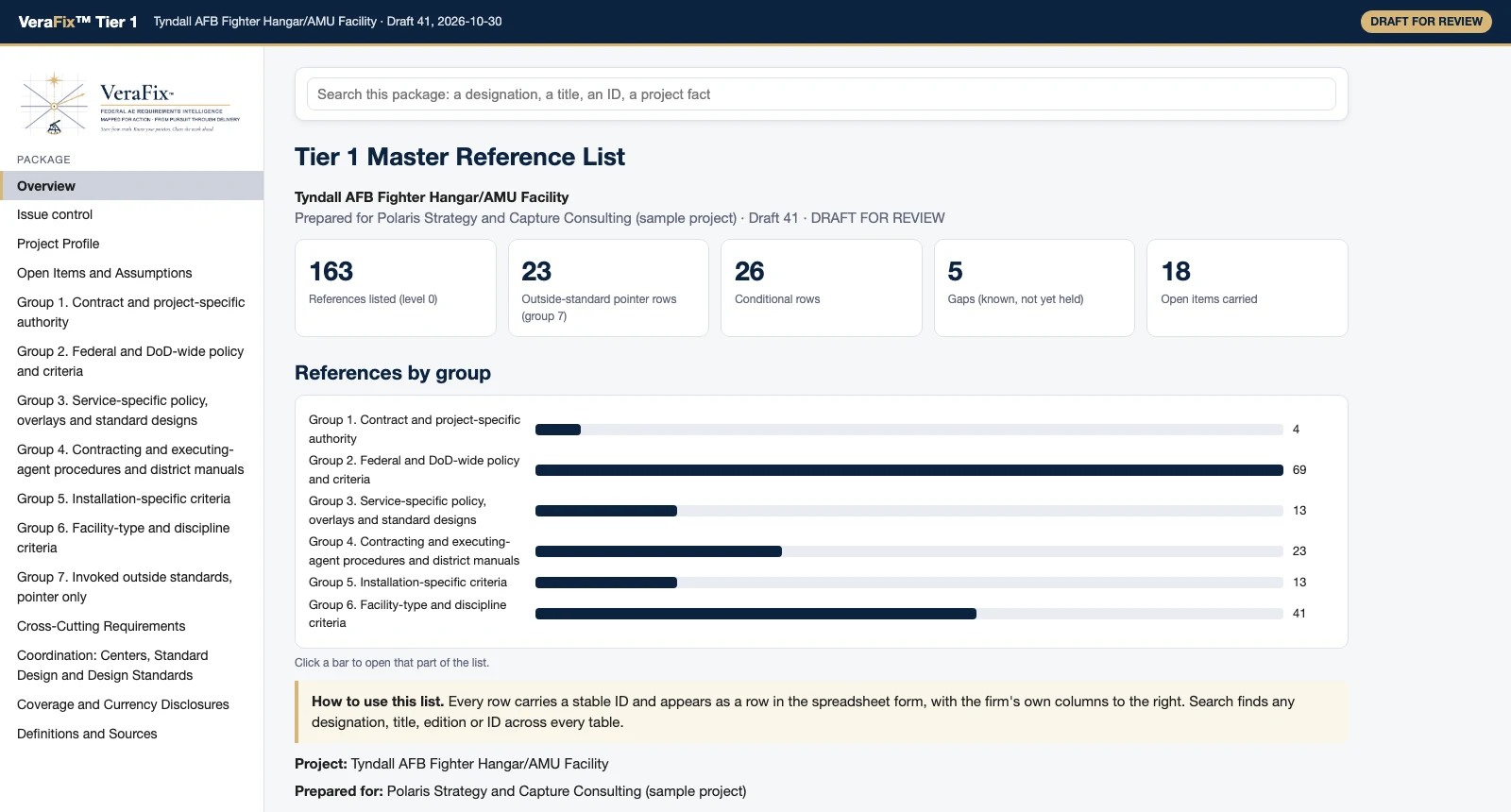
Tier 1 establishes the project’s reference starting position. It groups governing sources by criteria category and makes conditional items, open items, coordination points, and engagement needs visible before the firm begins its own research.
1 of 4
The actual opening screen groups the project’s reference landscape before the team opens an individual group.
Selected Sample Deliverables
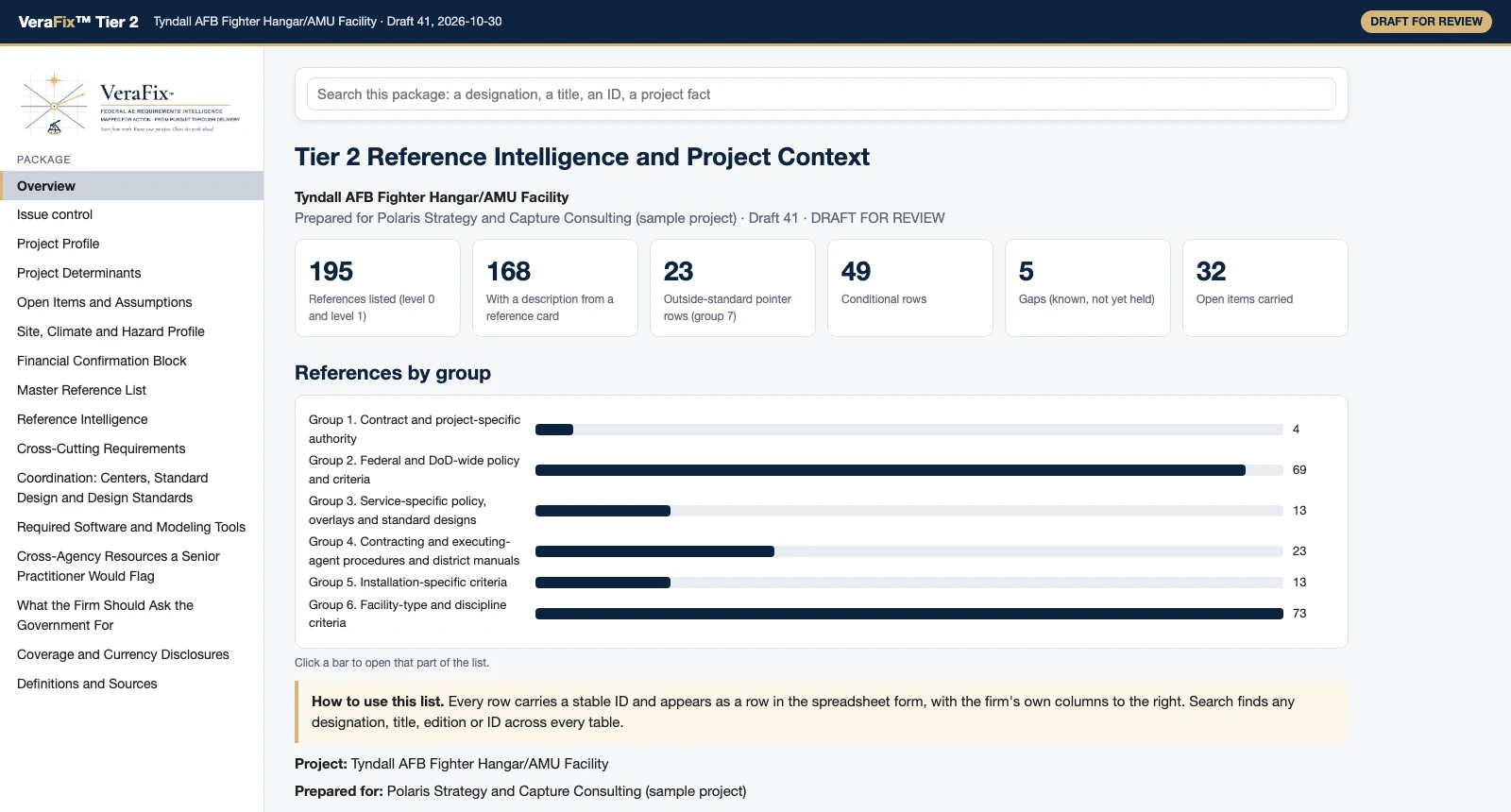
Tier 2 adds project context to the Tier 1 register. It explains the references in plain language and brings together project determinants, site, climate and hazard factors, tools or resources, and questions the firm may need to confirm with the Government.
1 of 5
The opening view groups the project’s reference landscape before the team opens the individual cards.
Selected Sample Deliverables
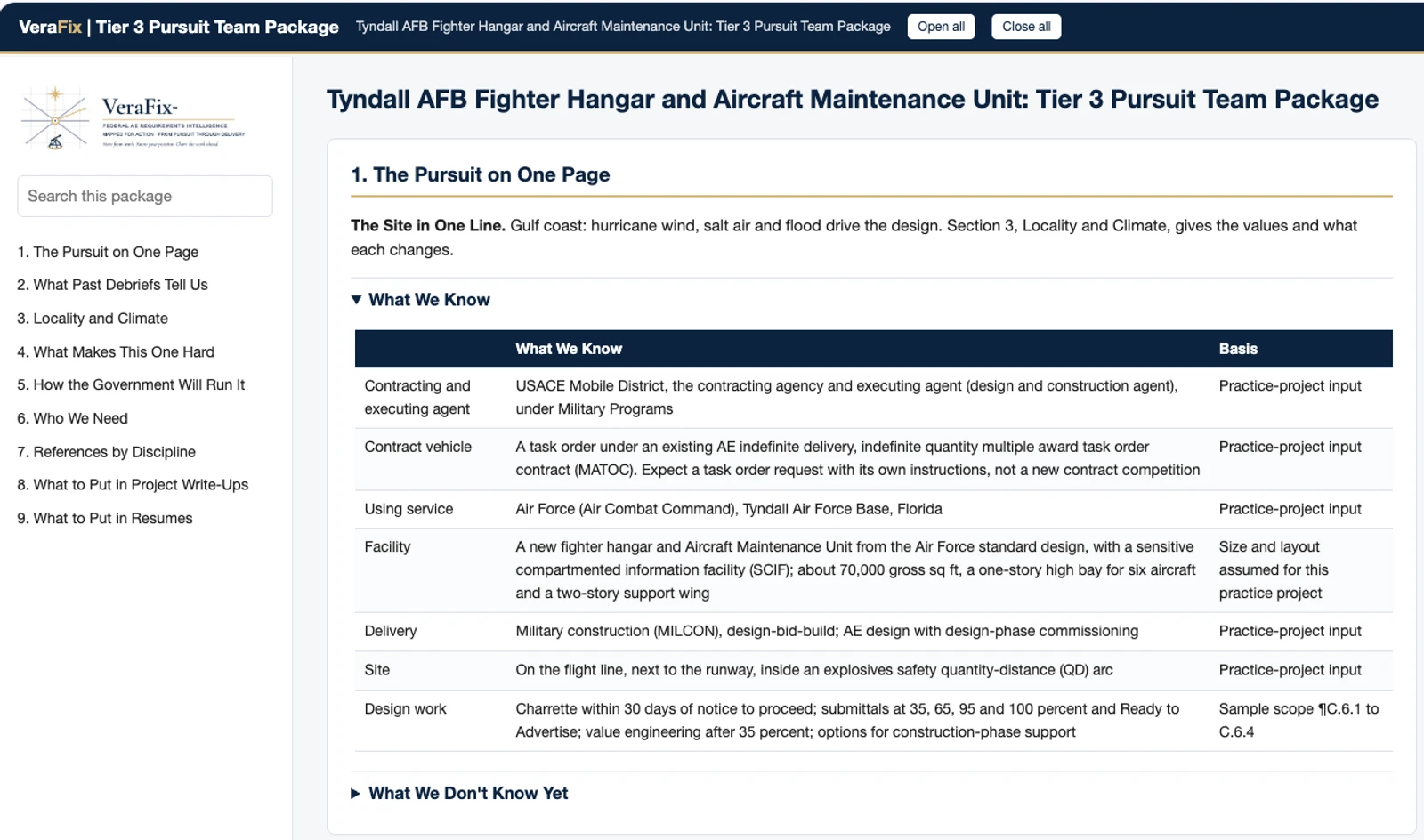
Tier 3 turns the project facts and reference base into a pursuit view. It brings together the project conditions, Government process, technical challenges, and needed roles and experience to help the team develop its project write-ups, resumes, and technical approach.
1 of 9
A Tyndall Mobile District practice-project example separates confirmed project facts from their basis.
Selected Sample Deliverables
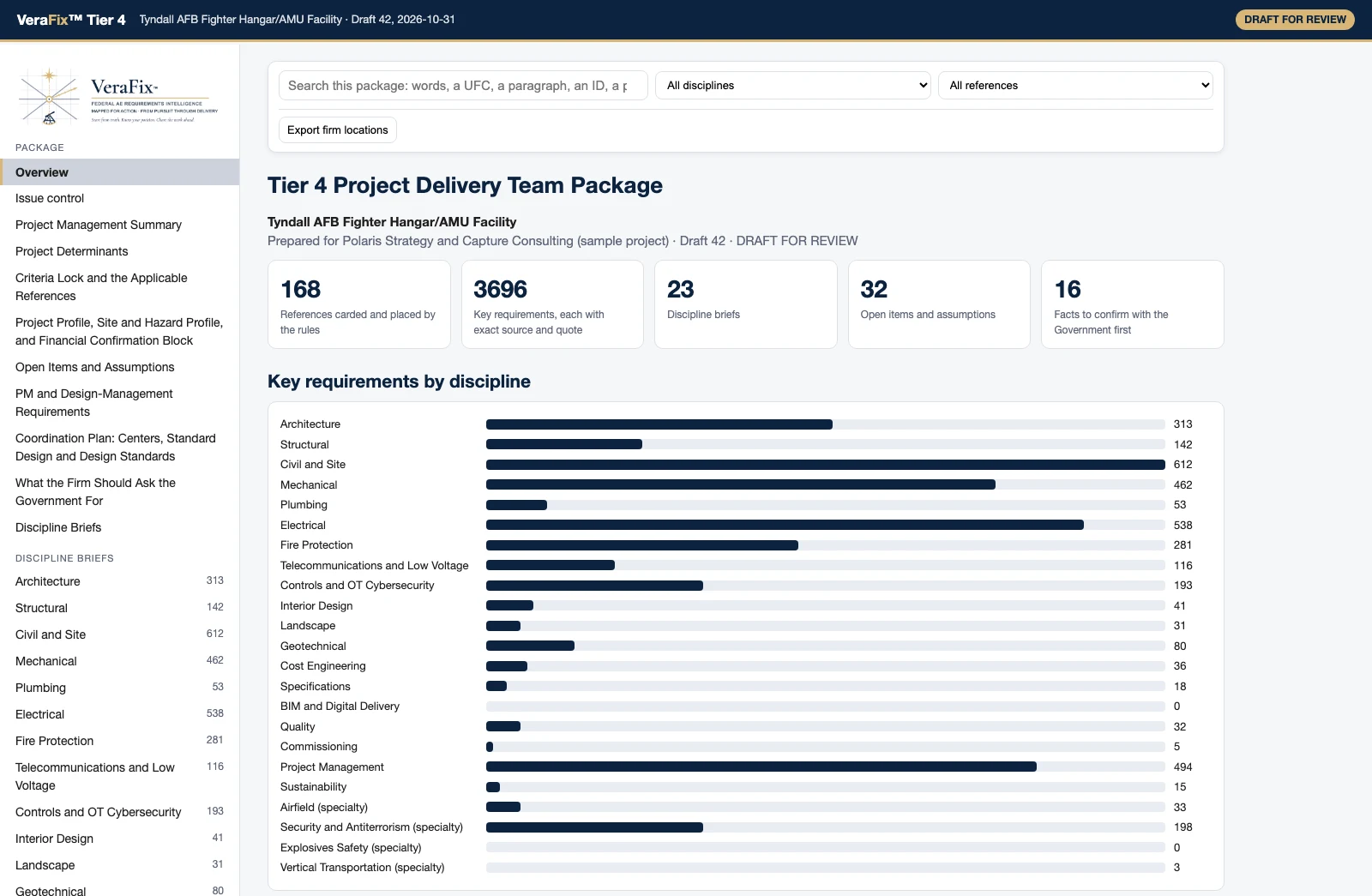
Tier 4 organizes the project for the awarded team. It brings together the criteria baseline, project conditions, requirements by role and discipline, coordination points, Government confirmations, and discipline briefs.
1 of 10
The opening screen organizes captured key requirements by discipline. Select a bar to open that discipline brief.
Four Deliverable Tiers
VeraFix™ is a project-specific service, not software. The firm receives finished deliverables tailored to one project's scope, sources, and decisions.
What Applies
A project-specific reference register, grouped by governing source and criteria category, with conditional items, open items, coordination points, and the Government or other parties the firm may need to engage. Entries identify designation, title, category, applicability basis, and a public-source link.
Pick it when: your team will do its own research and just needs the right list to start from.
Useful for: Establishing the reference library and confirming the criteria baseline.
See Tier 1 Master Reference List ExampleWhat Each Reference Is
Everything in Tier 1, plus concise descriptions of each reference, its principal subject matter, the disciplines or roles that use it, and how it connects to the criteria chain. It can also incorporate firm-provided project information and relevant site, hazard, acquisition, and delivery context.
Pick it when: you want more than the list, so your team knows what each document means and the facts of the site.
Useful for: Project orientation, kickoff preparation, management planning, and shared team understanding.
See Tier 2 Reference Intelligence and Project Context ExampleWhat the Pursuit Team Needs
A pursuit-focused briefing that brings together the project's defining requirements, technical challenges, delivery obligations, external coordination, review pathways, and the factors affecting the proposed team and approach. It helps the team develop project write-ups, resumes, and its technical approach.
Pick it when: you are pursuing the work and want to show, beyond the solicitation, that you know the technical requirements and how the agent runs design and construction.
Who reads it: Capture leaders, proposal managers, principals-in-charge, project managers, contract managers, and proposed technical leaders.
See Tier 3 Pursuit Team Package ExampleWhat the Delivery Team Must Do
A discipline- and role-organized requirements briefing for the project team. It presents captured requirements with their governing reference and source location, identifies responsible and coordinating parties, and surfaces required analyses, decisions, submittals, reviews, and deliverables.
Pick it when: you want your team to know as much as possible, fast: who and what is required to build the team, set the fee, and design to the right requirements using the right processes.
Who reads it: Principals, project managers, design managers, quality managers, architects, engineers, technical specialists, and consultants.
See Tier 4 Project Delivery Team Package ExamplePick one package. Move up later on the same project, and what you paid is credited toward it (terms apply).
Request a quote and tell us what you know about the project. We confirm the recommended package, scope, fee, delivery date, and any information still needed before work begins.
Request a VeraFix™ QuoteOptional Project-Planning Outputs
Optional modules use the same project intelligence to support risk, workload, quality, and team-readiness decisions. They are scoped separately and do not create an additional deliverable tier.
A project-ready register for the risks, impacts, mitigation actions, and action owners the team needs to discuss together.
A shared project register can trace each risk to its governing source or project condition and support cost and schedule risk analysis discussions when that work is in scope.
See Risk Register ExampleEstimated sheet ranges by discipline and submission milestone, with the assumptions, exclusions, uncertainty, and project-complexity drivers behind the forecast.
A requirements-informed draft tailored to the firm's authorized quality procedures, review gates, responsibilities, and lessons learned for Project Manager and Quality Manager approval.
Draft Sample Available on RequestProject-specific training slides for whole-team orientation or individual disciplines, organized around their requirements, interfaces, risks, responsibilities, and deliverables.