VeraFix™Criteria Watch

Who is watching the criteria, tools and processes your team relies on?

The federal criteria, tools and processes your work is held to change frequently throughout the year. Know when they do.

Twice a month, covering changes from the past 30 days. Each report identifies what changed in the Government's design criteria, tools, resources, processes and procedures, links to the source, and states what is different. It is monitored daily, then read and edited by a federal AE practitioner before it reaches you.

Nobody Tells You When Things Change

A UFC is reissued with a change number. A guide specification is revised in a quarterly release. USACE posts a bulletin that changes how a class of projects is delivered. A standard design package is replaced and keeps the same title. An Army Center of Standardization adds a new link or tool to its page, and nothing announces it. The same goes for the online tools and resources teams rely on, and for the processes and procedures that govern how work is submitted, reviewed and selected.

These changes are posted across several Government websites, often without notice to the firm. The team may discover them only when a Government reviewer points them out in a proposal or deliverable. Using the wrong reference or process can mean rework at the firm's expense, or a lost project or contract.

In most AE firms I have worked with, no one is assigned to watch. It is nobody's job.
Someone Has to Do This

Keeping the watch means checking a number of Government websites, reading what changed against the source, working out who in the firm needs to know, and writing it up for them. In the firms I have worked with, that falls to a senior architect, engineer or program manager who already has other work to do.

Criteria Watch does that work. Twice a month, covering changes from the past 30 days. Each report covers criteria, online tools and resources, processes and procedures, with a link to the source and why it matters to your team. Your team starts from a place of truth.

Start with changes worth attention

Sample Deliverable, Practice Project (Illustrative)

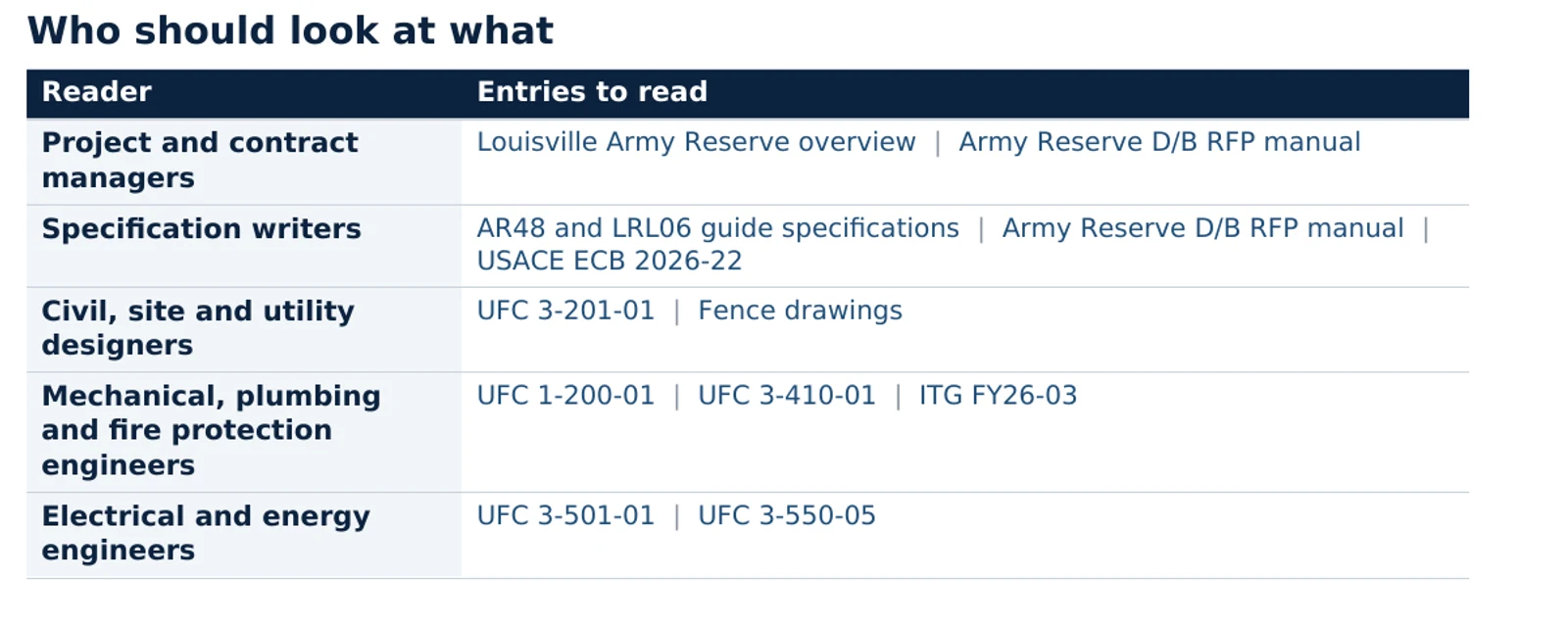
Start with Changes Worth Attention

The opening identifies main developments for the stated coverage window.
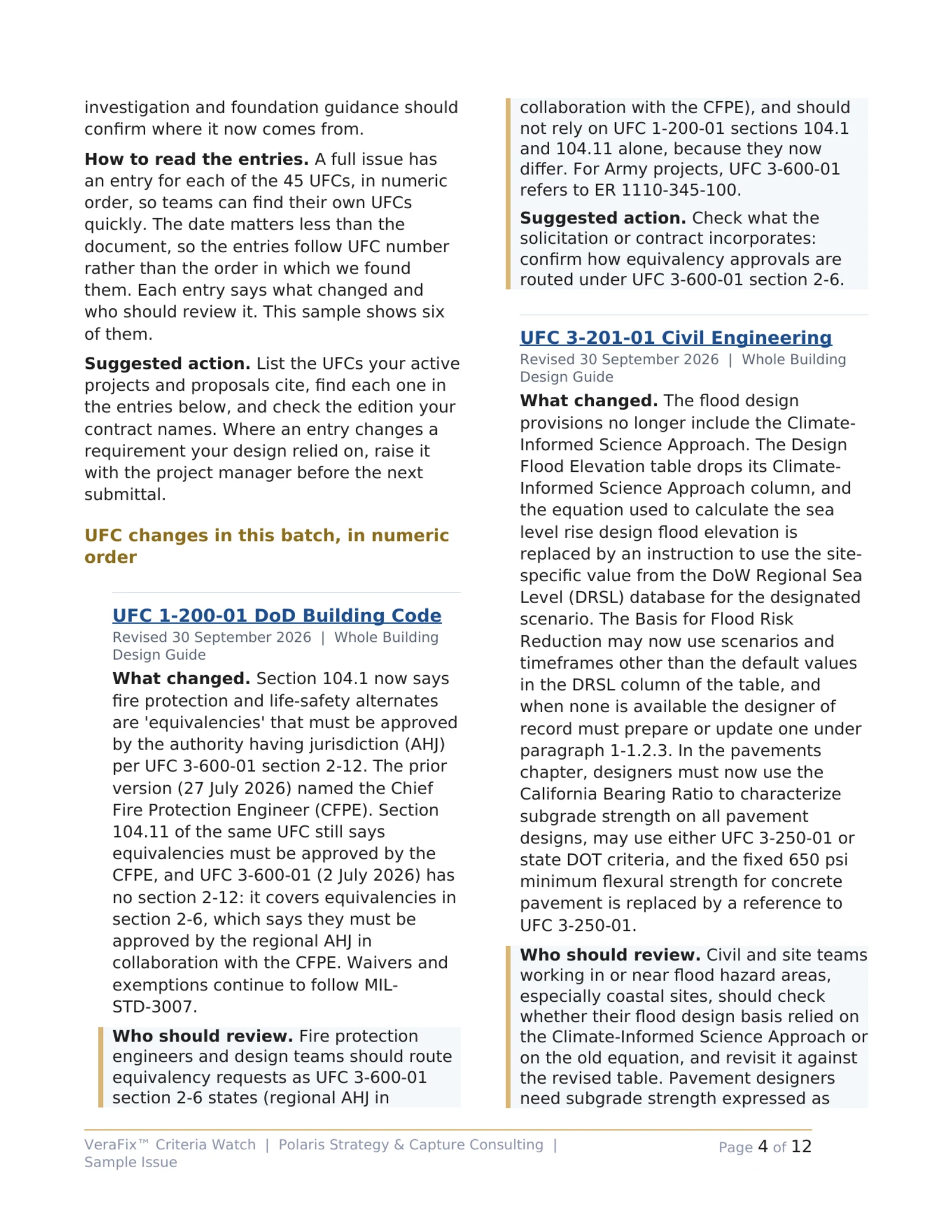
See change source and who should review

Sample Deliverable, Practice Project (Illustrative)

See Change Source and Who Should Review

A complete sample entry shows the change and source check.

Why This Exists

I spent 24 years in the Navy and finished in command of a submarine. Every submarine has a sailor in the Engineering Department whose job most people never hear about: the Logroom Yeoman. Every update, revision and change to the boat's technical, operating and training manuals comes to that sailor, who sees that each one is entered, so that nobody aboard is working from a superseded page.

In that environment nobody has to be told why. People act on what the reference says, and the consequences of acting on the wrong one are severe.

Federal design work is a high-consequence environment too. The criteria are the references your teams act on. They change, and in most firms I know, no one is keeping the watch.

VeraFix™ Criteria Watch is that watch, kept for you. It serves the same end as VeraFix™: helping AE teams start from a place of truth.

What Arrives Twice a Month

  • From the Logroom. A short note from me on the two or three changes that matter most this cycle, and why.
  • New this cycle. Each change from the past 30 days: the document, a working link to the official source, what changed, and who in your firm should take a look. Entries cover changes to the criteria documents, significant policy, process, rule and law changes, and new or updated tools, best practices and training resources published on the sources we watch. A change can appear in two consecutive issues because each issue covers 30 days.
  • Still current. The 30 days before that window, in brief, so a missed issue costs you nothing.
  • Corrections. If we got something wrong, the next issue says so.

Each issue arrives as a PDF you can file with the project.

What We Watch

The coverage list is published and specific, because "everything" is a promise nobody can keep. From each source we report changes to criteria documents, significant policy, process, rule and law changes, and new or updated tools, best practices and training resources.

  • Joint DoD criteria: Unified Facilities Criteria, Unified Facilities Guide Specifications, and related criteria published through the Whole Building Design Guide
  • Army and USACE: Engineering and Construction Bulletins; headquarters Engineer Regulations, Manuals, Pamphlets and Technical Letters; Centers of Standardization and Centers of Expertise; Civil Works is included
  • Air Force and Navy: criteria and guidance published through the Whole Building Design Guide
  • Reserve and National Guard components: the criteria apply to work for the Army Reserve, the Air Force Reserve, the Air National Guard and the National Guard Bureau, and changes to them are reported when they affect that work
  • Policy, rules and law: significant policy changes, and rules and laws that affect how federal AE work is procured, designed and delivered, reported from official Government sources

Sources are added by name as they are brought under watch. Not yet covered: Veterans Affairs and National Park Service standards, installation design guides, and service publication sites beyond those listed.

How It Works

The listed sources are checked daily. When something changes, the change is confirmed against the official source and written up. I read every entry against the source and edit it before anything is sent. Nothing goes out without that review.

Criteria Watch comes out of the VeraFix™ system and shares its philosophy: start from truth.

See a Sample Issue

Open a sample showing the report format and selected entries. Its coverage window and sample status are stated in the PDF.

Open the sample issue

Subscriptions

  • Annual · $1,200 a year, which is $100 a month
  • Monthly · $120 a month

Twice a month, covering changes from the past 30 days, with up to five named recipients per subscription. A subscription starts with a signed order form, and invoices follow, due net 30. Annual subscriptions renew unless you give notice at least 30 days before the term ends. The order form has the full terms.

What is it worth to know that a reference, tool or process changed before it affects a proposal, design decision or submittal? And what would it cost the firm to keep that watch itself: assigning a senior practitioner to check the sources, compare changes, decide who needs to know, and write it up twice a month? Criteria Watch is $100 a month on an annual subscription. It gives the firm a reviewed report to start that conversation from the current source.

Use the contact form to request a subscription. The PDF order form remains available if the firm prefers it.

What Criteria Watch Is Not

Criteria Watch reports changes to the listed public sources. Entries identify changes and questions for the relevant disciplines to check. They do not determine the requirements of the firm's project or contract. Criteria Watch does not interpret the criteria for you, and it is not a substitute for reading the source document, which always governs. A change to a published criterion does not by itself change what your contract incorporates.

When the question becomes "what does this mean for our project," that is what a VeraFix™ engagement answers.

Explore VeraFix™

Questions

Aren't these documents, tools and resources free?

Yes, the Government publishes them. What you are paying for is the watching and the reading: someone checking the sources every day and a practitioner telling you what changed and who should care.

Why not have someone on my team do this?

You can, and some firms do. The work is checking the sources, reading what changed against the source, deciding who in the firm needs to know, and writing it up. Criteria Watch is that work, done twice a month, so your senior people read one report and your team starts from the current position.

How is this different from a specifications subscription?

A specifications service gives you access to documents. Criteria Watch tells you when the documents changed and how.

Who may receive Criteria Watch?

Each subscription covers up to five named recipients at the subscribing firm. Issues may be sent only to those named recipients and may not be forwarded to others.

What if nothing changed?

You still get an issue. If nothing in the listed sources changed in the past 30 days, it says so plainly, and the 30 days before that are still there. A quiet period is reported as a quiet period, not left for you to assume.

What if you miss something or get something wrong?

The next issue carries the correction, plainly. If an error could lead a firm to act wrongly, a correction goes out the same day.

Do you cover industry standards such as ASTM or ASHRAE?

No. When a Government criterion changes which edition of an industry standard it cites, we report that. We do not summarize the content of privately published standards.

Is this affiliated with the Government?

No. See the note below.

Someone Should Be Keeping the Watch